
Etsy vs Your Own Checkout Page for Physical Products
Etsy takes 20%+ per sale in stacked fees, but marketplace traffic is real. An honest comparison for sellers weighing their own checkout page.
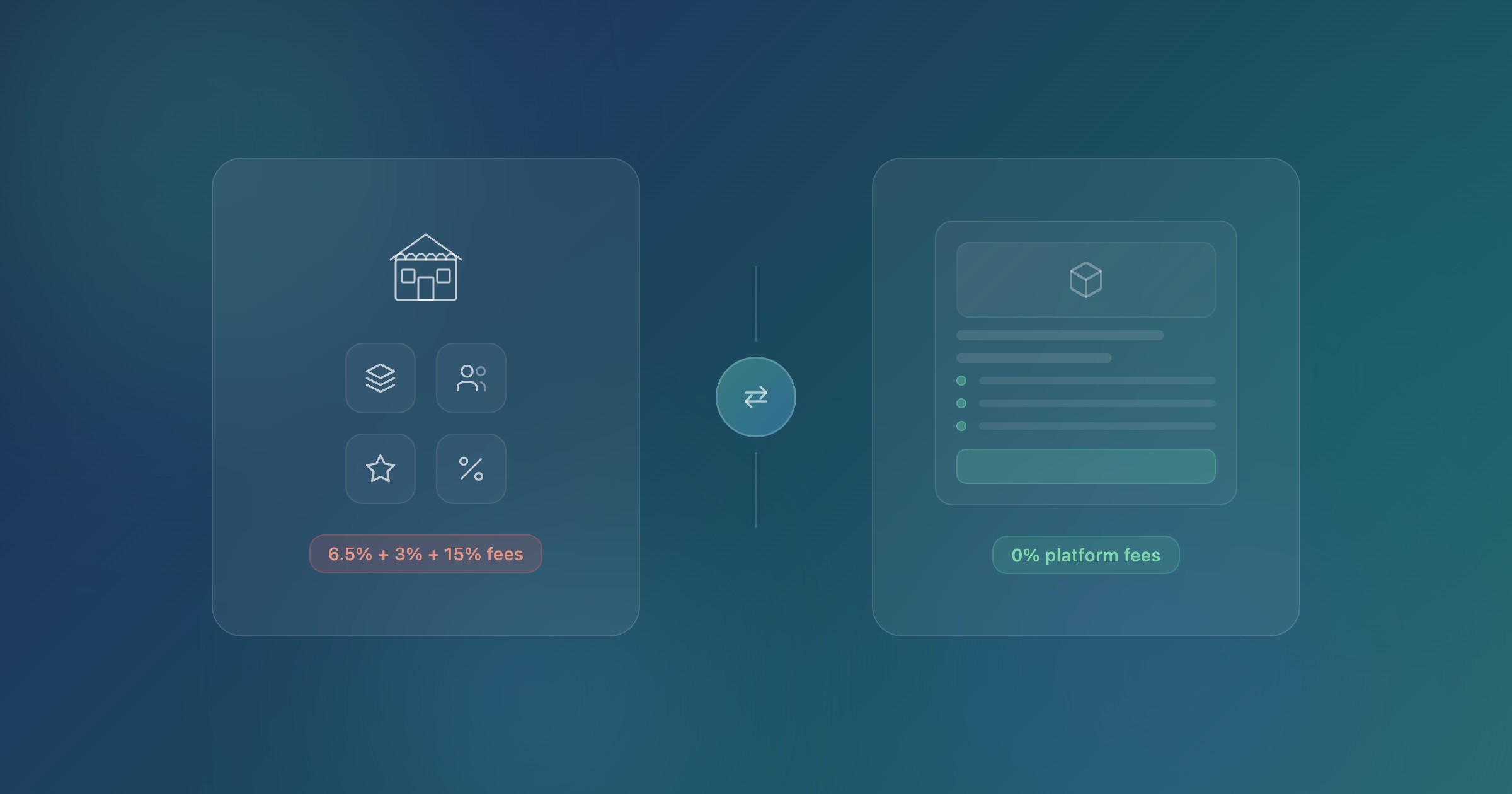
Take a $40 candle set with $5 shipping on Etsy. Here's what you pay: $0.20 listing fee + $2.93 transaction fee (6.5%) + $1.60 payment processing (3% + $0.25) = $4.73 minimum. That's about 10.5% of the order.
Now add Etsy's offsite ads. If the buyer clicked one of Etsy's Google or Facebook ads before purchasing—something you can't opt out of once you earn more than $10,000/year—Etsy adds a 12% fee on the order. That pushes the total to $10.13, or roughly 22.5% of the sale. That's before you've paid for the wax, the jars, or the box you ship it in.
This isn't an argument that Etsy is a bad platform. Etsy has over 85 million active buyers searching for handmade and unique products. That marketplace traffic is genuinely valuable. The question is whether those fees make sense for your business—specifically, whether the traffic Etsy sends you justifies what you're paying.
The Full Etsy Fee Stack
Most sellers know about Etsy's transaction fee. Fewer realize how many fees stack on top of each other.
| Fee | Amount | When It Applies |
|---|---|---|
| Listing fee | $0.20 per item | Every listing + $0.20 again on each sale for multi-quantity listings; unsold listings auto-renew every 4 months |
| Transaction fee | 6.5% of order total | Every sale (calculated on price + shipping) |
| Payment processing | 3% + $0.25 | Every sale |
| Offsite ads | 12-15% of order total | When buyer clicked an Etsy-placed ad (mandatory at 12% above $10K/year; 15% under $10K but you can opt out) |
| Currency conversion | 2.5% | International sales in a different currency |
| Regulatory operating fee | ~0.3-2.3% | Sales in certain countries (UK, France, Italy, Spain, others) |
The hidden compounding. Etsy's 6.5% transaction fee is calculated on the total order amount including shipping. If you charge $8 for shipping, Etsy takes $0.52 of that. You're paying a percentage fee on money that covers your actual shipping costs.
What the fees look like at different price points
$25 product + $5 shipping ($30 order):
- Without offsite ads: $3.30 (~11% of order total)
- With mandatory offsite ads (12%): $6.90 (~23% of order total)
$50 product + $8 shipping ($58 order):
- Without offsite ads: $5.96 (~10.3% of order total)
- With mandatory offsite ads (12%): $12.92 (~22.3% of order total)
$100 product + $10 shipping ($110 order):
- Without offsite ads: $10.90 (~9.9% of order total)
- With mandatory offsite ads (12%): $24.10 (~21.9% of order total)
The percentages stay consistent: roughly 10% without offsite ads, 22% with. Whether you sell a $25 item or a $100 item, Etsy takes a similar cut.
What Etsy Gives You for Those Fees
Being honest about Etsy's value matters. The fees aren't pure profit extraction—they fund a marketplace that provides real benefits.
- Marketplace traffic. Over 85 million active buyers search Etsy for products. Buyers type "handmade ceramic mug" into Etsy's search bar, and your product appears. You didn't have to build that audience.
- Built-in trust. Etsy has brand recognition. Buyers trust Etsy's purchase protection, review system, and dispute resolution. A first-time buyer is more likely to purchase from an Etsy shop than from an unknown website.
- Discovery features. Etsy SEO, Star Seller badges, category browsing, curated collections, and gift guides all drive organic traffic to listings.
- Payment infrastructure. Etsy handles the entire payment flow, currency conversion, and buyer refund protection.
- Shipping tools. Calculated shipping rates, discounted USPS/FedEx labels, and tracking integration.
If most of your sales come from Etsy search—from buyers who found you through the marketplace—these features are what you're paying for, and they may be worth it.
When Etsy Fees Stop Making Sense
The tipping point is straightforward: when you bring your own traffic, you're paying marketplace fees for marketplace features you're not using.
This happens when:
- You drive sales from Instagram, TikTok, Pinterest, or email. You share your Etsy link in your bio or stories, and followers buy from your shop. Etsy didn't acquire that customer—you did.
- Customers search for your brand name. They type "Jade's Ceramics" into Google, not "handmade mugs" into Etsy. Brand recognition means you've outgrown marketplace discovery.
- Offsite ads hit on sales you would have gotten anyway. Etsy shows an ad for your product on Google. A customer who already follows you on Instagram clicks it, and you lose 12%. You had no way to prevent this.
- You're paying 6.5% on repeat customers. A loyal customer who's bought from you three times still costs you the full transaction fee on every order.
The math on self-sourced traffic
A seller doing $3,000/month on Etsy pays approximately $315/month in base fees (transaction + processing + listing renewals)—about 10.5% of revenue. If 60% of that traffic comes from the seller's own social media and email list, that's roughly $190/month in fees on customers Etsy didn't bring them.
Over a year, that's $2,280 in fees on self-sourced traffic alone—money that could go toward better materials, packaging, or marketing.
What a Checkout Page Looks Like for Physical Products
Selling physical products outside of a marketplace used to mean building a full online store. That's changed. Tools like cartt.io (and others) let you create a single checkout page with the features physical product sellers actually need.
Here's what a modern checkout page offers for physical goods:
- Shipping configuration. Set flat shipping rates to up to 25 countries with delivery time estimates. No complex carrier integrations to configure—just set your price per region.
- Inventory tracking. Set stock quantities per product. When inventory runs out, the product automatically shows as sold out. If two orders come in simultaneously for the last item, the oversold order gets automatically refunded.
- Custom fields and variants. Let buyers pick size, color, scent, or any other option via dropdown menus or free-text fields. Up to 10 custom fields per product.
- Tax calculation. Stripe handles sales tax automatically based on the buyer's shipping address. No manual tax configuration needed.
- Fulfillment dashboard. View pending orders, mark them as shipped, add tracking numbers. Customers get notified when their order ships.
- Customer order status page. Buyers can check their order status with just their email and order number—no account creation required, no "where's my order?" emails clogging your inbox.
- Conversion tools built in. Testimonials, countdown timers, trust badges, product image galleries, and urgency elements are part of the template. No app marketplace, no extra monthly fees.
The cost: $9.99-19.99/month plus Stripe's standard processing fee (2.9% + $0.30 per transaction). No transaction fees, no listing fees, no offsite ads fees.
Feature Comparison
| Feature | Etsy | Your Own Checkout Page |
|---|---|---|
| Marketplace traffic | Yes (85M+ active buyers) | No — you bring your own |
| Platform/transaction fee | 6.5% + $0.20/listing | 0% |
| Payment processing | 3% + $0.25 | 2.9% + $0.30 (Stripe) |
| Offsite ads fee | 12% mandatory above $10K/year (15% under, but opt-out available) | None |
| Product reviews | Built-in with buyer verification | Via testimonials section |
| Shipping | Calculated rates + discounted labels | Flat rates, up to 25 countries |
| Inventory tracking | Yes | Yes (with oversell protection + auto-refund) |
| Custom fields/variants | Variations system | Dropdown + text fields (up to 10) |
| Order fulfillment | Mark shipped + tracking | Mark shipped + tracking + customer status page |
| Page design | Limited to Etsy's template | Full customization (visual builder, 5 templates) |
| Customer relationship | Etsy owns the relationship | You own it — direct emails, repeat buyers |
| Monthly cost | Free (fees per sale) | $9.99-19.99/month |
The tradeoff is clear. Etsy gives you traffic you don't have to build. A checkout page gives you control and lower fees, but only if you already have traffic.
The Hybrid Approach
This doesn't have to be all-or-nothing. Many physical product sellers run both simultaneously:
- Keep Etsy for organic marketplace buyers. People who find you through Etsy search, gift guides, or category browsing. These are customers Etsy acquired, and the fees reflect that value.
- Use your own checkout page for direct traffic. Your Instagram bio link, TikTok shop link, email newsletters, and Pinterest pins all point to your checkout page. These are customers you acquired, and you keep the margin.
- Shift gradually as direct traffic grows. As your brand strengthens and more customers come to you directly, a larger share of revenue flows through your checkout page at lower fees.
This approach lets you keep Etsy's discovery benefits while reclaiming margin on traffic you already own. There's no penalty for selling on both—Etsy doesn't require exclusivity.
Decision Framework
Stay on Etsy if:
- Most of your sales come from Etsy search. If buyers find you through the marketplace, you're getting value from the fees.
- You sell many products and need a browsable catalog. Etsy handles categories, search, and product browsing. A single checkout page isn't built for 50+ products.
- You rely on Etsy's review system for social proof. Hundreds of verified reviews build trust that's hard to replicate on a new page.
- You're just starting out. Etsy's marketplace discovery helps new sellers get their first customers without an existing audience.
Add your own checkout page if:
- You drive significant traffic from social media or email. If you're sending customers to Etsy from Instagram, you're paying marketplace fees on non-marketplace traffic.
- You sell 1-5 products. A focused checkout page with conversion optimization works better than a marketplace listing for small catalogs.
- You want full control over your brand and page design. Etsy's template is Etsy's template. Your checkout page looks however you want.
- The fee math doesn't work at your volume. Run the numbers on your last 3 months. If a significant chunk of fees is on self-sourced traffic, the savings are real.
- You're tired of offsite ads eating your margins. On your own page, there's no mandatory 12% fee when a customer clicks an ad you didn't ask for.
A Real-World Scenario
The ceramics maker. Jade sells handmade mugs on Etsy in 3 designs, each available in 2 sizes. She does $4,000/month in sales, with about 70% of her traffic coming from her Instagram account where she posts process videos.
Etsy takes roughly $420/month in base fees on her sales (~10.5%). About $295 of that is on customers who came from her Instagram—customers she acquired through her own content.
Jade sets up a checkout page for her Instagram bio link. She configures custom fields so buyers can pick their mug size, sets up flat-rate shipping to the US and Canada, and enables inventory tracking for each design. Her Instagram traffic ($2,800/month) now costs $19.99/month subscription plus ~$100/month in Stripe processing instead of $295 in Etsy fees.
She keeps her Etsy shop open for the 30% of sales that come from Etsy search. Those customers found her through the marketplace, and the fees are worth the discovery.
Monthly savings: ~$175. Over a year, that's over $2,000—enough to invest in better packaging, materials, or a larger Instagram ad budget that drives even more direct traffic.
If you're a physical product seller driving traffic from social media or email, it might be worth running the fee math on your last few months of Etsy sales. cartt.io lets you set up a checkout page with shipping, inventory, and fulfillment in about five minutes—see if it changes the numbers for your business.
Related reading: cartt.io vs Shopify: Do You Need a Full Store or Just a Checkout Page? · How to Design a High-Converting Checkout Page